Shim mark: a pair of opposing wedges

Sawdust and Shims

A working journal of small repairs, paint and trim, written a job at a time.

Paint and Finishes

Brushwork, sheen, sanding between coats and the things that go wrong on the second pass.

Cutting a clean line where wall meets ceiling

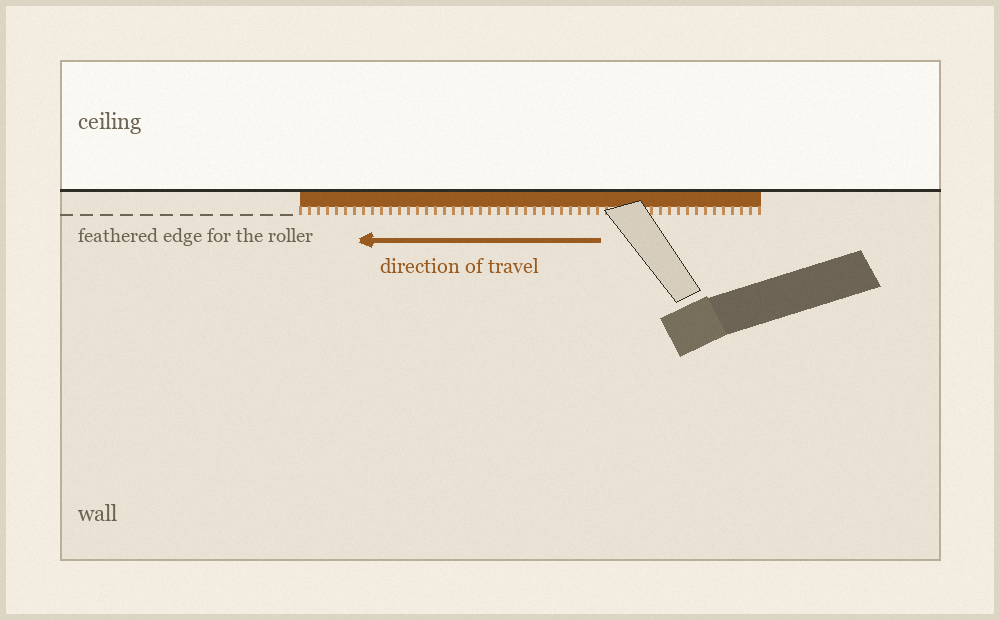
Diagram of a paint brush held flat against a wall just below the ceiling line, showing the bead of paint running ahead of the bristle tips.
A loaded brush held flat to the wall, with the ferrule kept off the ceiling line.

Filed under Paint and Finishes

Cutting in is the part of painting that decides whether a room looks finished or looks attempted. Everything else is coverage. The line where the wall stops and the ceiling begins is at eye level for the whole life of the room, and a wobble there is the first thing a visitor's eye lands on, long before anyone notices that the roller left a light patch behind the door.

Read the rest of this entry

Choosing a sheen before choosing a colour

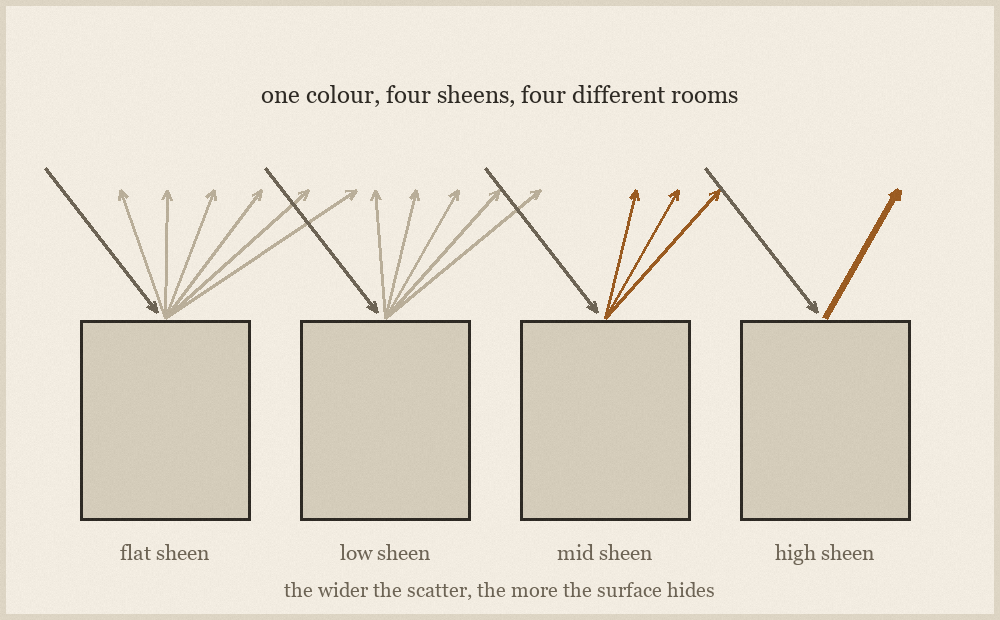
Diagram comparing four painted panels of the same colour at flat, low, mid and high sheen, with arrows showing how much light each reflects toward the viewer.
The same colour at four sheen levels, showing how reflected light changes what the eye reads.

Filed under Paint and Finishes

People choose colour for weeks and sheen in the last thirty seconds at the counter, and then wonder why the finished room does not look like the sample card. Sheen changes how much light bounces back at you, and light bouncing back at you is most of what you perceive as colour. The same tin, applied flat and applied at a higher sheen, will read as two different colours on two walls of one room.

Read the rest of this entry

Why the second coat looks worse than the first

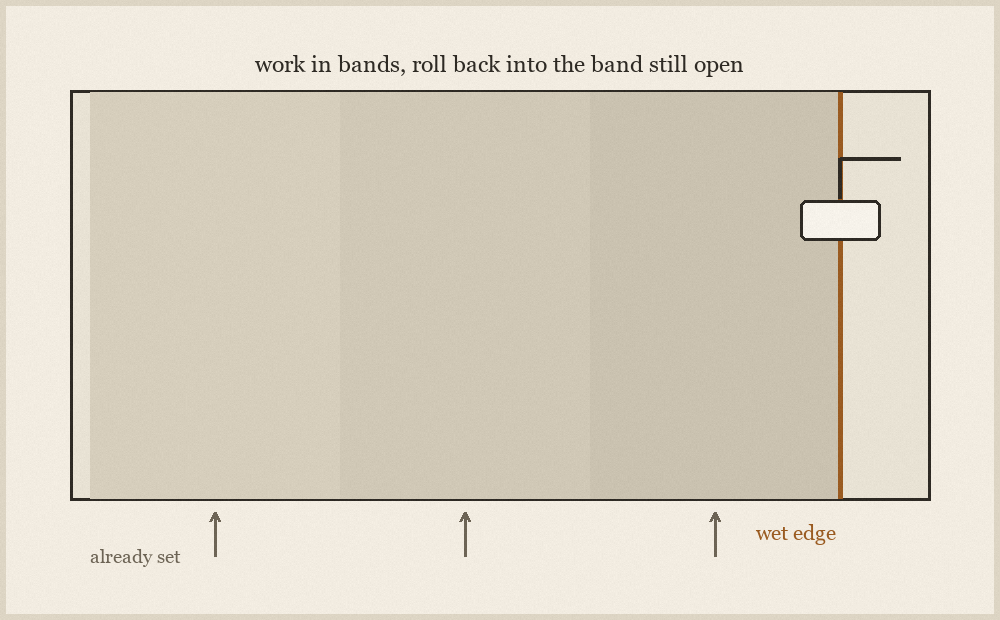
Diagram of a paint roller travelling across a wall in overlapping passes, with the boundary between the still-wet area and the drying area marked.
A roller working a wet edge across a wall, with the previous pass still open.

Filed under Paint and Finishes

It is a common and demoralising experience: the first coat goes on and looks encouraging, the second goes on and the wall is suddenly covered in streaks, patches and visible laps. The instinct is to blame the paint. Usually the paint is fine and the second coat has simply revealed what the first coat was hiding.

Read the rest of this entry

Sanding between coats without sanding through

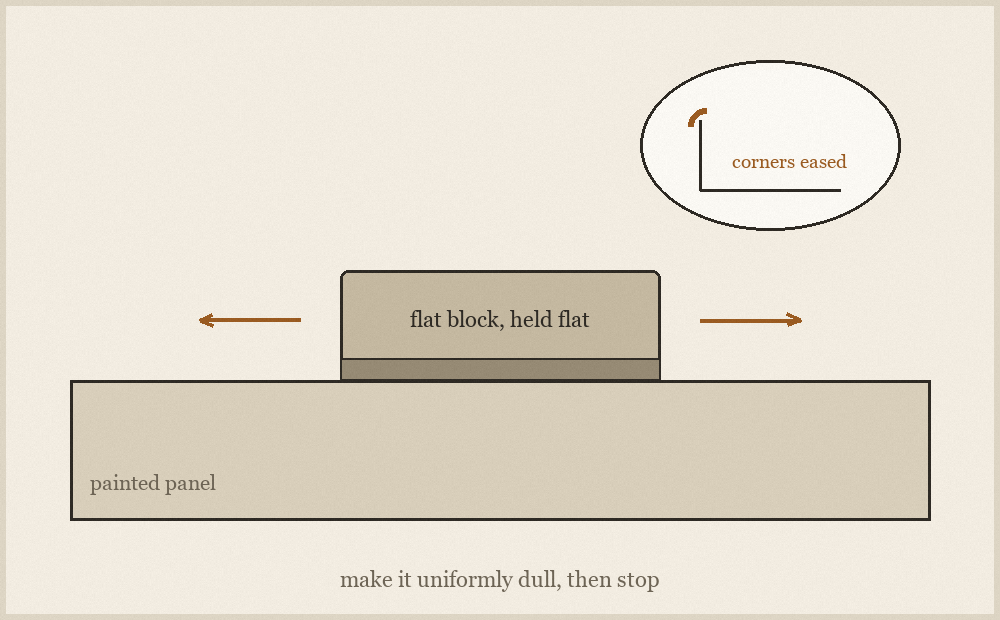
Diagram of a hand sanding block held flat on a painted panel, with an inset showing the eased corners of the abrasive paper.
A flat block used flat, with the edges of the paper eased to prevent tracking.

Filed under Paint and Finishes

Sanding between coats is not about removing material. It is about knocking down the grain and the dust nibs that rose into the last coat so the next one has a flat surface to sit on. Once you hold that idea, the technique follows: light, flat, fine, and quick. Almost every failure comes from treating it as shaping rather than smoothing.

Read the rest of this entry

Labels

  • Paint and Finishes (4)Brushwork, sheen, sanding between coats and the things that go wrong on the second pass.
  • Walls and Trim (3)Plaster and board repairs, finding what is behind the surface, and fitting trim to rooms that are out of true.
  • Floors (3)Boards, thresholds, squeaks and the preparation that decides how a floor behaves later.
  • Tools and Materials (3)What a tool is actually for, what a first kit needs, and keeping an edge worth using.
  • Outdoors (1)Work that has to survive weather, frost and ground that moves.