Shim mark: a pair of opposing wedges

Sawdust and Shims

A working journal of small repairs, paint and trim, written a job at a time.

Floors

Boards, thresholds, squeaks and the preparation that decides how a floor behaves later.

Undercutting door casing before the floor goes down

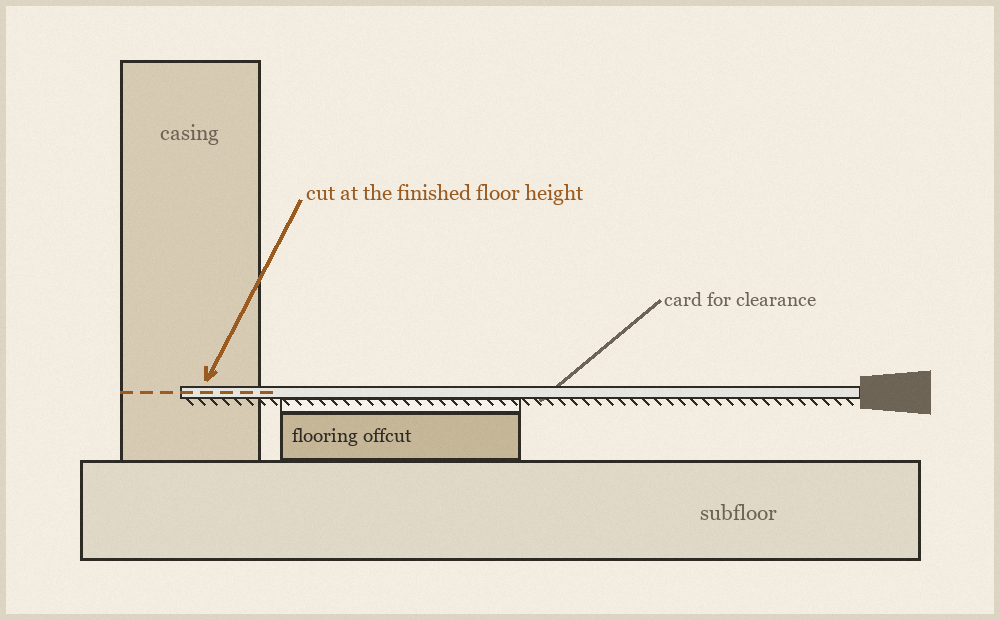
Diagram of a flush-cutting saw resting on an offcut of flooring beside a door casing, showing the cut line set at the height of the finished floor.
An offcut of the new floor used as a height gauge for the saw.

Filed under Floors

There are two ways to get a new floor past a door casing. You can cut the floor around the shape of the casing, or you can cut the casing and slide the floor underneath. The second is faster, more forgiving and looks better, and the only reason it is not universal is that it has to be done before the floor is laid, when the temptation is to get boards down and worry about details later.

Read the rest of this entry

Acclimating boards, and what happens when you skip it

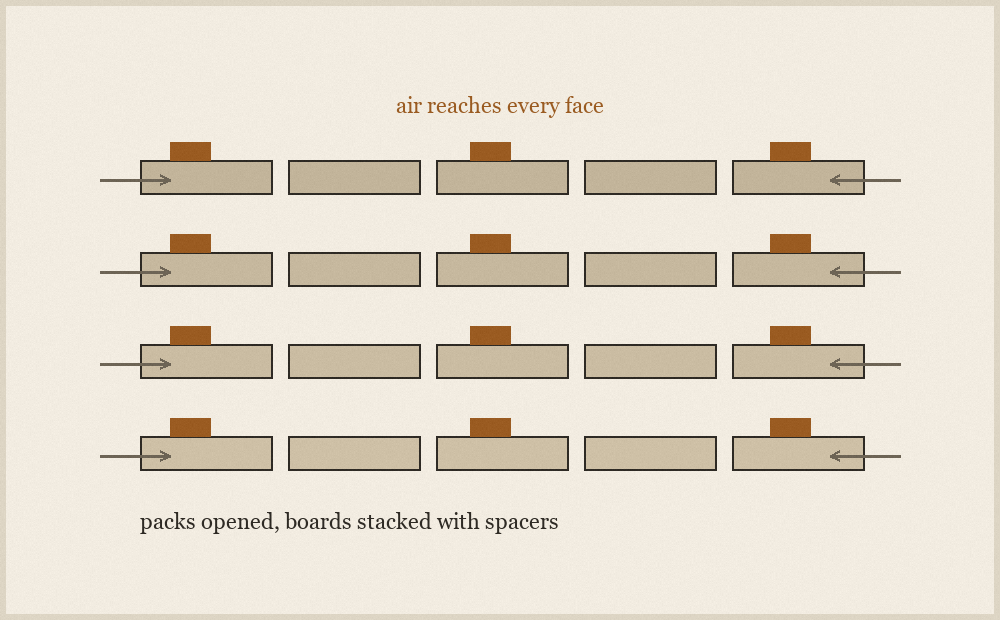
Diagram of flooring packs stacked with timber spacers between the layers, allowing air to circulate around each board in the room where the floor will be laid.
Boards stacked in loose layers with spacers between them, opened in the room they will live in.

Filed under Floors

Timber takes up and gives off moisture until it is in balance with the air around it, and as it does so it changes size across the grain. Every problem that shows up in a wood floor months after it was laid is a version of this one fact. A floor laid dry in a damp room swells and buckles; a floor laid damp in a dry room shrinks and opens gaps between every board.

Read the rest of this entry

Fixing a squeaking floor from above

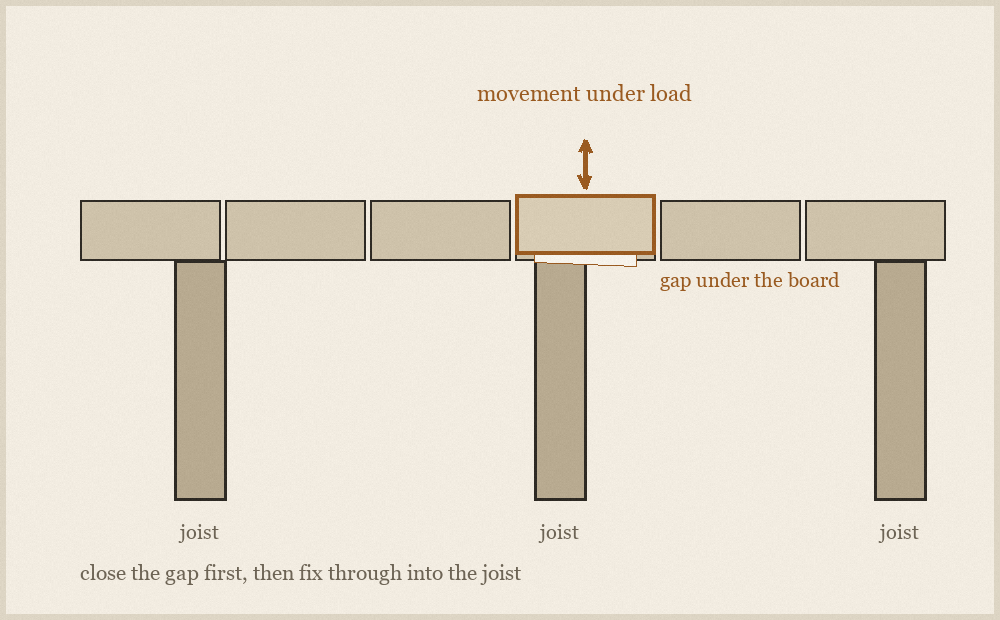
Cutaway diagram of floorboards over a joist, showing a gap under one board and an arrow marking the movement that produces a squeak.
A board rising and falling against a fixing as the load moves across it.

Filed under Floors

A floor squeak is movement, and the movement is almost always a board rising off its support under load and dropping back as the load passes. The noise itself is a nail shank rubbing in its hole, or two edges of timber moving against each other. Find which of those two it is and the repair is straightforward. Guess, and you will fix half the squeaks in the room and create a few new ones.

Read the rest of this entry

Labels

  • Paint and Finishes (4)Brushwork, sheen, sanding between coats and the things that go wrong on the second pass.
  • Walls and Trim (3)Plaster and board repairs, finding what is behind the surface, and fitting trim to rooms that are out of true.
  • Floors (3)Boards, thresholds, squeaks and the preparation that decides how a floor behaves later.
  • Tools and Materials (3)What a tool is actually for, what a first kit needs, and keeping an edge worth using.
  • Outdoors (1)Work that has to survive weather, frost and ground that moves.