
3 May 2015
Choosing a sheen before choosing a colour
Filed under Paint and Finishes
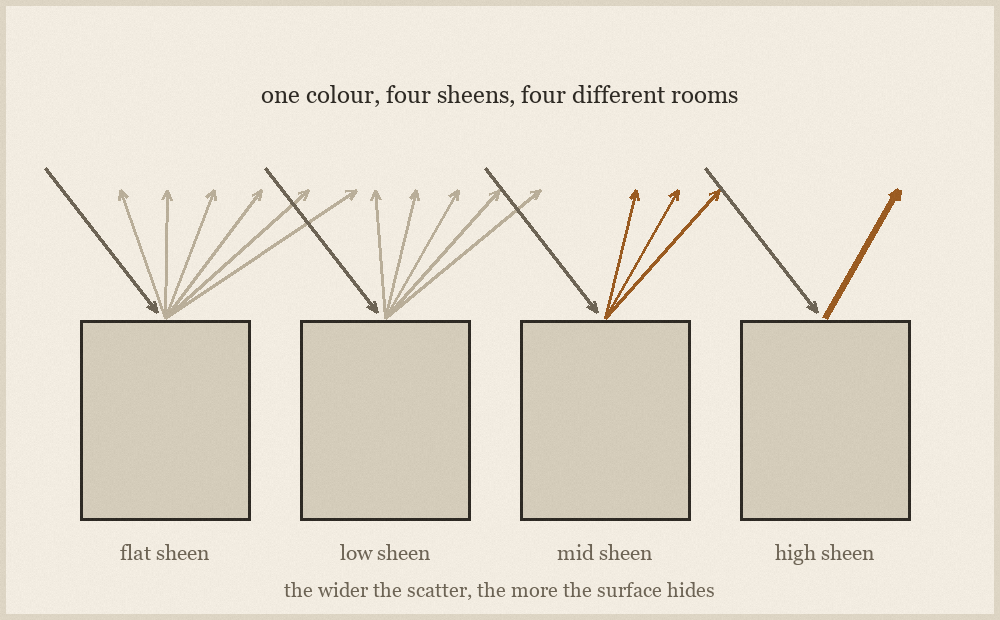
People choose colour for weeks and sheen in the last thirty seconds at the counter, and then wonder why the finished room does not look like the sample card. Sheen changes how much light bounces back at you, and light bouncing back at you is most of what you perceive as colour. The same tin, applied flat and applied at a higher sheen, will read as two different colours on two walls of one room.
What sheen is actually doing
A flat finish scatters light in every direction. That is why it hides surface irregularity so well: no single direction gets a concentrated reflection, so a slightly wavy wall reads as even. A higher sheen reflects more light coherently, so the wall returns a bright image of whatever is opposite it, and every hollow and ridge shows up as a distortion in that image.
The practical rule follows directly. The worse the surface, the flatter the finish should be. An old wall with a century of repairs in it wants the flattest finish you can live with. A new, carefully skimmed surface can carry sheen without embarrassment.
Where wear argues back
The reason not to put flat paint everywhere is that flat films are open and porous, and open films hold dirt and give up when you scrub them. Sheen comes from a harder, tighter film, and a tighter film wipes clean. So the choice is a negotiation between hiding the surface and surviving contact with it.
That negotiation resolves differently by room and by height. Ceilings almost never get touched and are lit at a grazing angle, so they take the flattest finish available. Trim, doors and anything at hand height take contact constantly and are small enough that surface flaws can be made good properly first, so they take the highest sheen in the house. Walls sit between the two, and the answer depends on whether the room is a hallway or a spare bedroom.
Testing it properly
Paint a sample on a loose board rather than on the wall, at least a hand span across, and give it the same number of coats the wall will get. One coat over a different colour is not the finish, and a patch painted directly onto the existing wall is contaminated by whatever is under it.
Then move the board around the room and look at it at different times of day: against the window wall where light strikes it flat, on the wall opposite the window where light rakes across it, and in the corner that never sees sun. A sheen that looks calm in the corner can look like glass on the window wall, and a colour that looks warm at midday can turn grey by the evening.
One more thing worth knowing before you commit: the higher the sheen, the less forgiving the application. Brush marks, roller laps and touch-ups all show more as sheen rises, and a touched-up patch in a high-sheen wall is visible from across the room even when the colour is identical, because the repair has a different film thickness. If a wall is likely to need patching, that is an argument for a flatter finish on its own.