
12 October 2014
Acclimating boards, and what happens when you skip it
Filed under Floors
Timber takes up and gives off moisture until it is in balance with the air around it, and as it does so it changes size across the grain. Every problem that shows up in a wood floor months after it was laid is a version of this one fact. A floor laid dry in a damp room swells and buckles; a floor laid damp in a dry room shrinks and opens gaps between every board.
What acclimating actually means
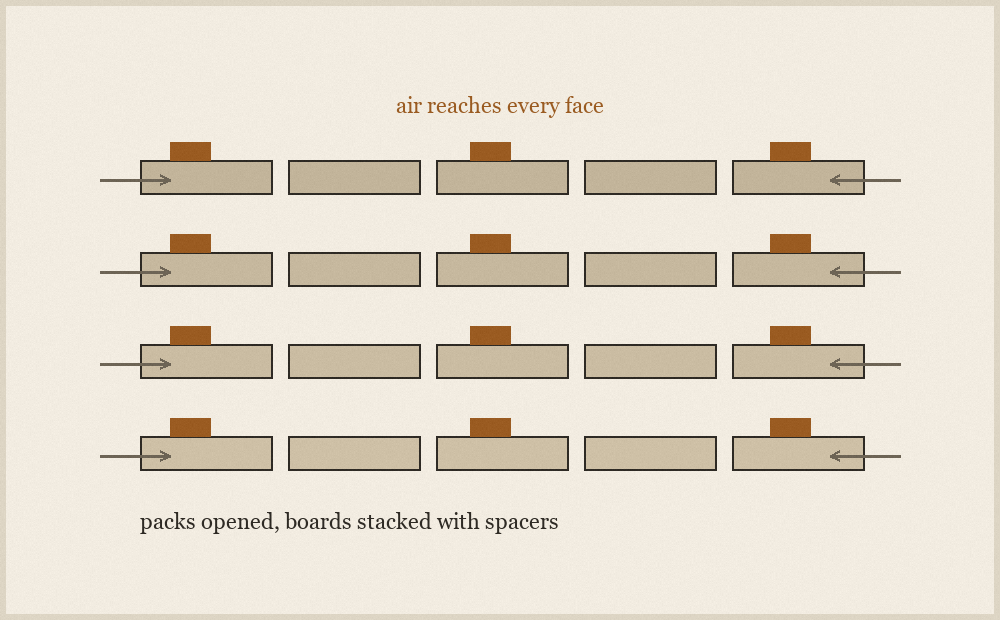
It does not mean leaving sealed packs in the hallway for a weekend. Sealed packs are sealed: the wood inside is still at whatever moisture content it had when it was wrapped. Acclimating means opening the packs, stacking the boards loosely with spacers between the layers so air reaches every face, and leaving them in the room where they will be laid, with that room at its normal working temperature.
The room matters as much as the boards. If the heating is off, or plaster is still drying, or the windows have been open for a week, the boards are equilibrating to conditions that will not exist again. Get the room to something like its ordinary state first, then bring the boards in.
How long
Longer than feels reasonable, and longer in an old house than a new one. The time it takes depends on how far the boards have to travel, so the useful question is not how many days have passed but whether the boards have stopped changing. If you have a moisture meter, take a reading on the day the boards arrive and again every day or two: when consecutive readings stop moving, the boards have arrived.
Without a meter, the crude substitute is weight and feel: boards that still feel cold and heavy compared with the room have water in them. It is a poor instrument, which is an argument for borrowing a meter rather than trusting a hunch on a floor that has to last.
Expansion gaps are not optional
Even a properly acclimated floor moves with the seasons, so the perimeter gap is what absorbs that movement. Leave it continuously around every wall and around every fixed obstruction — pipes, hearths, thresholds — and leave it at the correct width for the width of the room rather than whatever the spacers in the box happen to be. A wide room moves more than a narrow one.
The gap is only useful if it stays empty. Adhesive squeezed into it, filler run around the edge, or a skirting fixed down through the floor instead of into the wall all remove the gap while leaving it visible, and a floor with a blocked perimeter has nowhere to go but up. The first sign is usually a board that has lifted slightly in the middle of the room, a long way from the edge that is actually causing it.
If you skipped it
A floor that has opened gaps over a dry winter will often close most of them again by late summer, so the correct response to a newly gapped floor is to wait a full seasonal cycle before deciding anything is wrong. A floor that has buckled, on the other hand, will not flatten on its own: the perimeter has to be released first, and until that is done, every other remedy is cosmetic.