
24 August 2014
A small tool kit that covers most of a first year
Filed under Tools and Materials
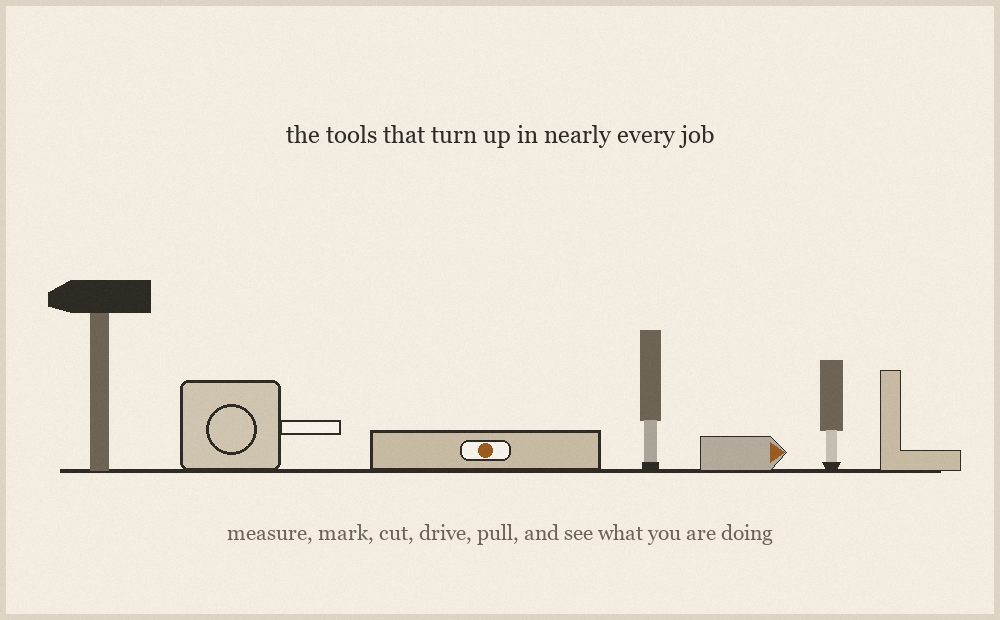
Most first tool kits are bought as a boxed set and half of it is never touched. The tools that actually earn their place are the ones that turn up in nearly every job regardless of what the job is, and there are fewer of them than the box suggests. What follows is a short list, with the reason each one keeps reappearing.
Measuring and marking
A tape measure with a stiff blade that stands out unsupported for a good distance, because half of measuring is done alone with nobody holding the other end. A combination square, which checks square, marks parallel lines at any distance from an edge and acts as a depth gauge. A pencil that is flat rather than round, because a round pencil rolls off every surface in the house and is never where you put it.
A spirit level long enough to span the thing you are levelling. A short level on a long workpiece averages a small section and reports it confidently, which is worse than no level at all. If only one level is bought, make it a medium one, and learn to check it by reversing it end for end: the bubble should read the same both ways.
Cutting
A utility knife with replaceable blades, used with fresh blades far more often than feels justified. Nearly every bad knife cut comes from forcing a dull blade, and blades are the cheapest consumable in the kit. A hand saw with hardened teeth for general cutting, and one sharp chisel of middling width, kept for cutting rather than for opening tins and levering things.
Driving and pulling
A claw hammer of moderate weight: heavy enough to drive without bouncing, light enough to control at the end of a long day. Screwdrivers in the two or three tip types your house actually uses, in more than one size each, because a driver that nearly fits is how a screw head gets destroyed. A cordless drill driver with a clutch, and the discipline to set the clutch rather than leaving it on the highest setting.
A pair of pliers and a small pry bar cover most of the taking-apart half of the work, which is the half beginners are least equipped for. Almost every repair begins by removing something that was fixed by someone who did not expect it to come off again.
The things that are not tools
Eye protection that is comfortable enough that you actually wear it, because uncomfortable protection sits on the bench. Hearing protection for anything powered. A dust mask rated for the dust you are making, kept where the work is rather than in a drawer. Knee protection, once you have spent a day on a floor.
Finally, a light. Not the room light: a movable work light you can put where the work is. More mistakes come from not being able to see the line than from not owning the right tool, and a directional light raking across a surface shows you every defect that overhead lighting politely conceals.